 Verity
Why do we continually trust our most sensitive personal data to monolithic software platforms that treat privacy as a premium add-on rather than a foundational baseline? As an infrastructure engineer who spends most of my time analyzing DNS queries and network routing protocols, I constantly evaluate how consumer applications interact with data at the lowest technical levels. I have developed a clear stance on this issue: the era of the "all-in-one" security and utility app is effectively over. Users do not need a single, bloated dashboard that attempts to manage every aspect of their digital lives poorly. Instead, effective security requires highly specific, modular tools that solve distinct vulnerabilities without demanding unnecessary permissions.
Counterarguments often suggest that consolidating services into one application reduces friction for the average user. While convenience is a valid metric, centralizing network routing, password management, and identity verification into a single point of failure introduces massive systemic risk. When that single provider experiences a breach, your entire digital footprint is exposed simultaneously. By isolating different functions—separating your network layer defenses from your identity management—you create isolated compartments that are vastly harder for data brokers to profile.
Acknowledge the economic pressure on digital software subscriptions
We cannot discuss software utility without addressing the current economic reality. Consumers are scrutinizing their digital subscriptions more aggressively than ever. According to recent 2026 data from Harvard Business School analyzing the impact of recent tariff increases, overall inflation is hovering persistently close to 3%, making basic cost-of-living management more challenging for the average household.
This macroeconomic shift directly impacts how people buy and retain mobile applications. A recent Vistage report highlighted that only 57% of U.S. workers saw their pay outrun inflation recently, while a staggering 83% of Americans stated that saving money is a bigger priority now than in past years. When discretionary income shrinks, tolerance for applications that charge high monthly fees for redundant features drops to exactly 0. Users are auditing their devices, actively deleting expensive "super apps" in favor of lean, single-purpose utilities that require less overhead and deliver immediate, measurable results.
Demand authenticity from the companies building your tools
Beyond cost, there is a fundamental crisis of trust in the software market. We are seeing a massive behavioral shift where users abandon applications that misrepresent their capabilities or disguise data-harvesting operations behind "free" features.
A 2026 study by Clutch on brand authenticity revealed that 97% of consumers consider authenticity a key factor in their decision to support a brand. More importantly, 81% report having actively stopped supporting a brand because it no longer felt genuine. In the context of a mobile app company, authenticity is not about marketing; it is defined by technical behavior. Does the application request access to your contacts when its stated purpose is to change your DNS settings? Does a calculator app need location permissions?
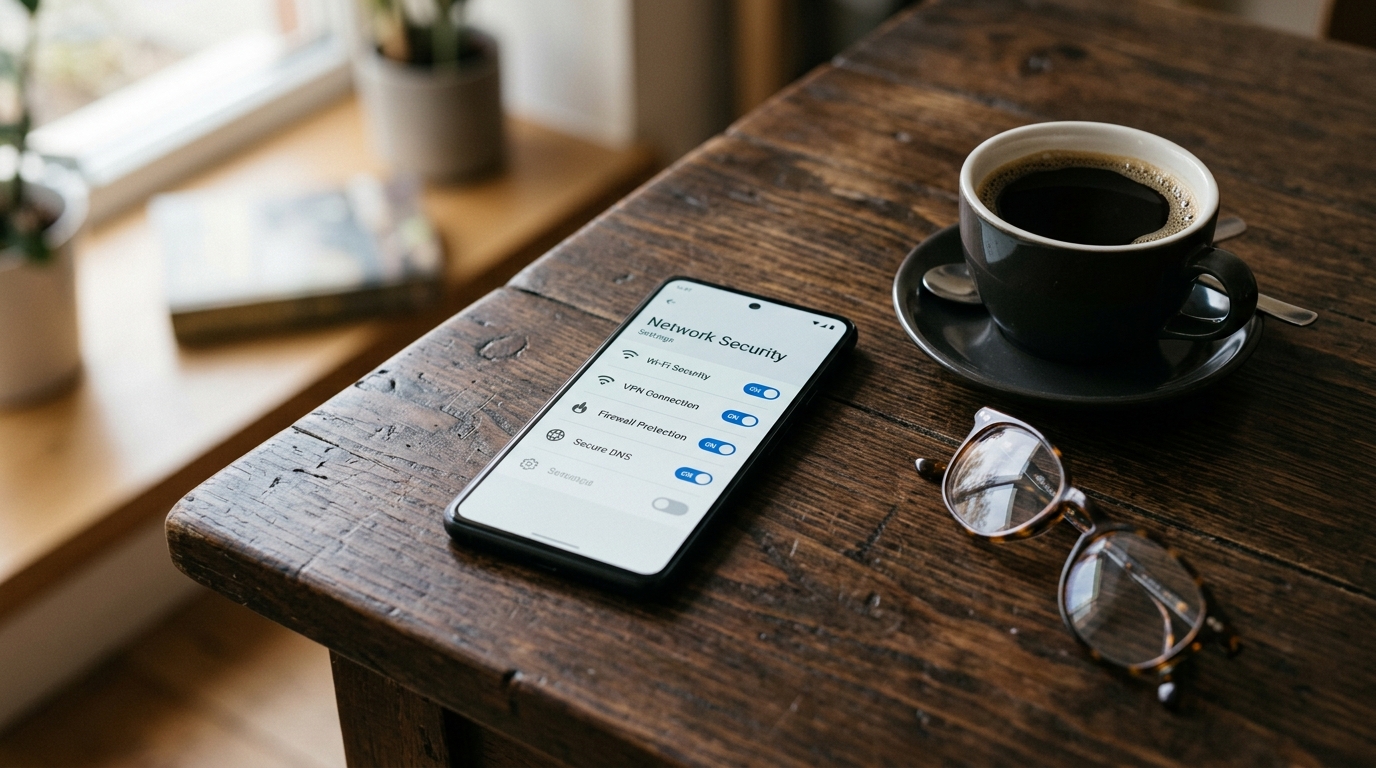
At Verity, our entire engineering philosophy is built around behavioral authenticity. We develop focused apps that execute their stated functions quietly and reliably, without expanding into unrelated territories to harvest user metrics. As my colleague Barış Ünal outlined in his recent post, Verity's Product Roadmap: How Long-Term Mobile App Decisions Stay Tied to Real User Needs, technical decisions must remain strictly tied to solving practical problems rather than padding feature lists to justify subscription costs.
Secure your network layer independently
The most critical component of your digital defense is the network layer. Every time you connect to a public Wi-Fi network or even your home ISP, your device must translate human-readable websites into IP addresses using a Domain Name System (DNS). If this process is unencrypted, any intermediary can monitor the exact domains you are visiting.
Many users rely on browser-based proxies or "secure browsers" thinking their traffic is protected. The reality is that these tools only encrypt the traffic within that specific application. Background processes, system updates, and other mobile applications on your device will still leak DNS queries in plain text.
To address this systemic vulnerability properly, you must apply protection at the operating system level. This is the precise engineering requirement behind VPN 111: Warp IP DNS Changer. By routing the entire device's connection through a secure tunnel and implementing custom DNS rules, you effectively blind local network administrators and ISPs to your destination traffic. It is a single-purpose utility designed to handle network routing and ad-blocking without interfering with your application layer identity.
Shield your primary telecom identity from third-party databases
While network protection secures your transit data, identity isolation secures your profile. The single most persistent identifier you possess is your primary mobile phone number. Unlike an email address, which is trivial to discard, a phone number is tied to strict telecom regulations, credit checks, and physical hardware.
When relying on major carriers like T-Mobile or Xfinity Mobile, your assigned number becomes a permanent anchor point for data brokers. It does not matter what hardware you are carrying—whether you are using an older iPhone 11 or have recently upgraded to an iPhone 14, an iPhone 14 Plus, or the flagship iPhone 14 Pro. The hardware provides local encryption, but the moment you submit your phone number into a web form for a discount code or service registration, that hardware security is irrelevant. You have freely handed over your primary indexing key.

This is why I strongly advocate for operational isolation when dealing with temporary verifications. If a service requires SMS verification merely to let you browse their platform or claim a promotional offer, you should never provide your permanent carrier number.
For these specific scenarios, utilizing Receive SMS&Temp Mail: CodeApp provides the necessary abstraction layer. It acts as a disposable endpoint, allowing you to receive the required verification texts or temp mail without linking the new account back to your actual identity. My colleague Ece Sönmez explored the mechanics of this in her detailed guide, Choose the Right Privacy Utility: Temporary Verification Tools vs Network Protection, which I highly recommend for users trying to map out their personal threat models.
Audit the permissions your current tools include
If we accept the data that economic constraints are tightening and consumer patience for inauthentic software is evaporating, the logical next step is a thorough audit of the tools we currently rely on. I advise users to review the permissions matrix of every utility on their device.
Examine what these applications actually include in their code base. A network routing tool should not include analytics trackers that log application usage. A temporary messaging endpoint should not include background location polling. The architecture of a secure digital life depends on choosing software that knows its boundaries and respects them.
The industry is inevitably moving away from the sprawling, multi-purpose platforms that dominated the last decade. As infrastructure complexity grows, security relies on compartmentalization. By carefully selecting independent, highly specialized tools for distinct tasks, you regain control over your data flow, reduce your attack surface, and ensure that a failure in one application does not compromise your entire digital identity.